Cryptography is the study of methods and techniques for developing and using coded algorithms to protect information and ensure secure communication, so that it can only be accessed by authorized parties possessing the appropriate decryption key or mechanism. In other words, cryptography protects communication by preventing unauthorized access to information.
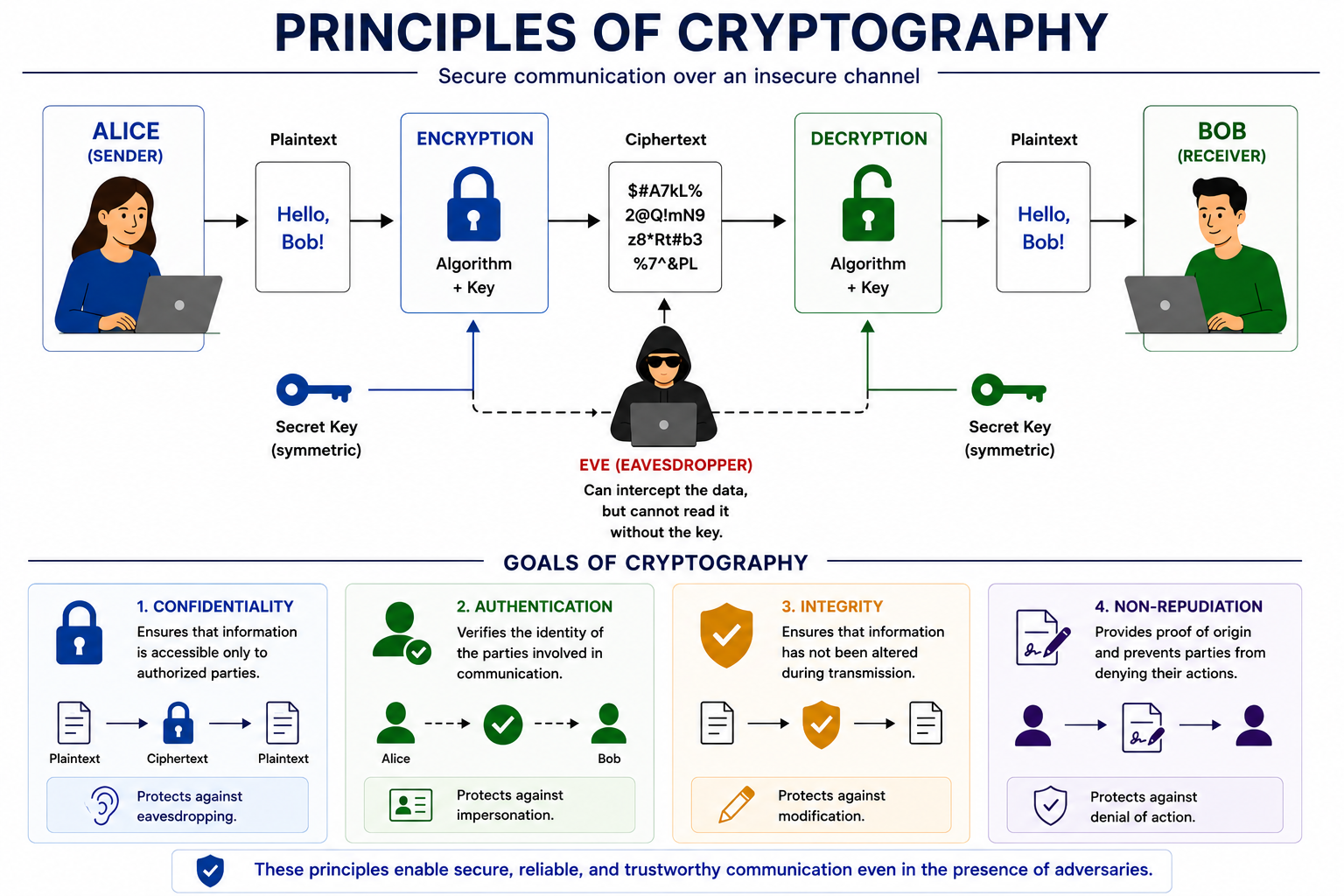
Today, cryptography plays a vital role in many aspects of everyday life, including electronic commerce, secure web communication, protection of confidential information, banking systems, healthcare technologies, and national security applications.
Beginning in the 1970s, modern cryptography evolved into a discipline based on mathematics and computer science. Modern cryptographic systems rely on publicly known algorithms and secret cryptographic keys, following Kerckhoffs’s Principle and focuses on two closely related objectives: secure key exchange and secure data encryption. Based on these objectives, modern cryptographic systems are generally classified into symmetric and asymmetric cryptography.
| Feature | Symmetric Cryptography | Asymmetric Cryptography |
|---|---|---|
| Principle | The same secret key is used for encryption and decryption |
A public key is used for encryption and a private key for decryption |
| Examples |
AES (Advanced Encryption Standard) DES (Data Encryption Standard) OTP (One-Time Pad) |
RSA (Rivest–Shamir–Adleman) ECC (Elliptic Curve Cryptography) DH (Diffie–Hellman Key Exchange) |
| Illustration |
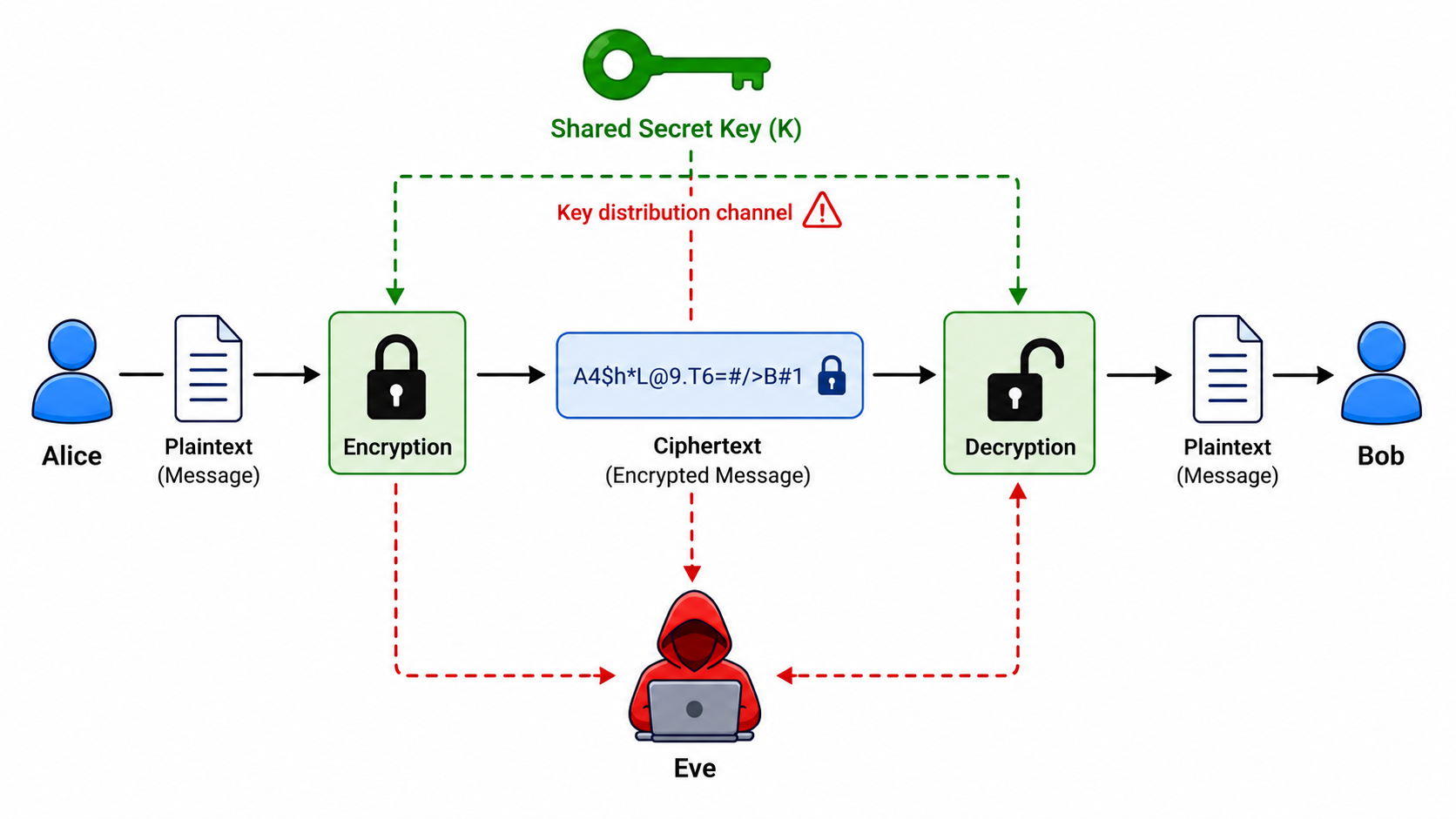
Image generated with AI assistance
|
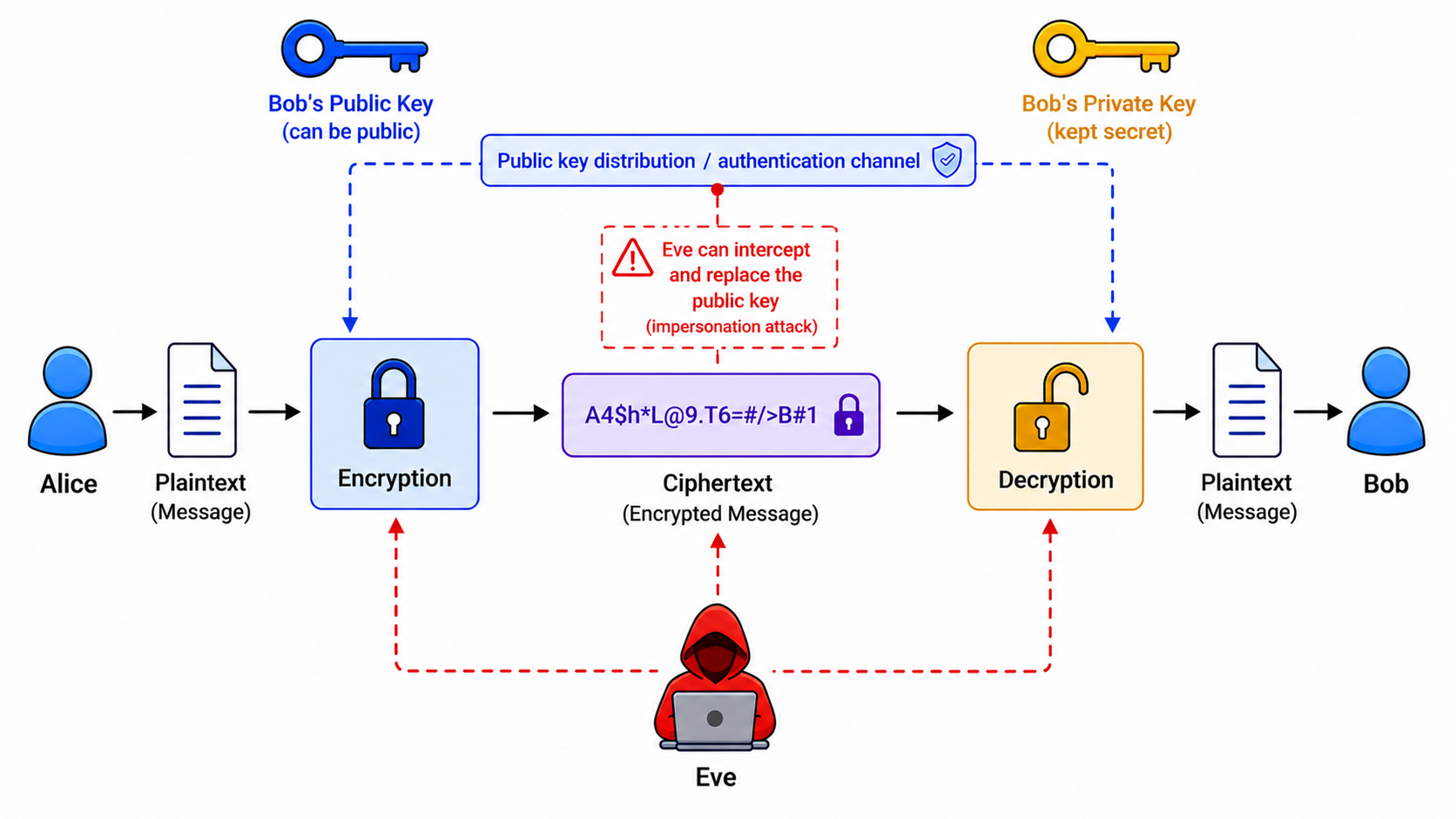
Image generated with AI assistance
|
| Advantages | Fast and efficient for large amounts of data | Enables secure key exchange and digital signatures |
| Limitations | Requires the secure distribution of a shared secret key over an insecure channel - the key distribution problem |
Computationally more expensive than symmetric methods; Quantum computers may break widely used cryptosystems; for example, Shor's algorithm can efficiently factor large integers, threatening RSA and related cryptosystems. |
The OTP is an encryption method that can provide perfect secrecy when used correctly. Its security relies on three fundamental rules:
- The key must be truly random.
- The key length must be equal to the message length.
- The key must be used only once for a single message.
The One-Time Pad principle can be implemented using different representations of characters. For example, characters may be represented by their ASCII codes or by binary values, in which case encryption is performed using the XOR operation.
The table below illustrates the OTP principle using ASCII codes. Each character of the message and the key is first converted into its numerical ASCII representation. Encryption is then performed using modular arithmetic on these numerical values.
| Position | 1 | 2 | 3 | 4 | 5 |
|---|---|---|---|---|---|
| Message | H | E | L | O | O |
| ASCII Code of Message | 72 | 69 | 76 | 79 | 79 |
| Key | k | E | y | 1 | 9 |
| ASCII Code of Key | 107 | 69 | 121 | 49 | 57 |
| Ciphertext ASCII Code: \((m[i] + k[i]) \bmod 256 \) | 179 | 138 | 197 | 128 | 136 |
| Decryption | |||||
| Ciphertext Character | ³ | Š | Å | € | ˆ |
| Recovered Plaintext: \((c[i] - k[i]) \bmod 256 \) | H | E | L | O | O |
In this exercise, the OTP is implemented using a custom alphabet of length \(N\), leading to the following general formulas:
- \(m[i]\) is the index of the message character at position \(i\),
- \(k[i]\) is the index of the key character at position \(i\),
- \(c[i]\) is the index of the ciphertext character at position \(i\),
- \(N\) is the size of the alphabet.
Choose Your Role:
Alice: Encrypt a message
2. a secret key.
3. Encrypt the message using the One-Time Pad method.
4. Share the ciphertext and the secret key with Bob.
RSA was introduced in 1978 by Ronald Rivest, Adi Shamir, and Leonard Adleman. It uses a public key for encryption and a private key for decryption. Its security relies on the difficulty of factoring the large number \(n = pq\).
Encryption: \( C \equiv M^{e} \pmod n \)
Decryption: \( M \equiv C^{d} \pmod n \)
where \(M\) is the plaintext, \(C\) the ciphertext, \((e,n)\) the public key, and \((d,n)\) the private key. The exponents \(e\) and \(d\) are chosen such that \[ e\,d \equiv 1 \pmod{\varphi(n)}. \] This relationship ensures that a message encrypted with the public key exponent \(e\) can be recovered using the private key exponent \(d\).
Generate RSA Key Pair:
Encryption: enter the message to be encrypted and the RSA public key in the format \(e,n\)
Decryption: enter the ciphertext as comma-separated integers and the RSA private key in the format \(d,n\)
In modern cryptographic systems, security is based on computational difficulty of solving certain mathematical problems. Quantum computers could solve some of these problems efficiently, posing a threat to cryptographic systems.
Quantum cryptography relies on the laws of quantum mechanics. Any attempt to intercept quantum information disturbs the quantum state, making eavesdropping detectable.

- Represents qubits and their superpositions
- Describes initialization of quantum registers
- Quantum gates correspond to unitary operators
- The state \(|\psi \rangle \) changes via quantum gates
- All quantum algorithms are sequences of unitary operations (quantum circuits)
- Ensures reversibility of quantum computation
The state of the system after measurement becomes
- Explains probabilistic outcomes and collapse of superpositions
- Converts qubit superpositions into classical bits for readout
- Determines the output of quantum algorithms
- Implements projective measurements in quantum circuits
- Describes multi-qubit systems and entanglement
- Allows operations on subsystems or individual qubits
- Fundamental for quantum circuits, quantum teleportation, and entanglement-based algorithms
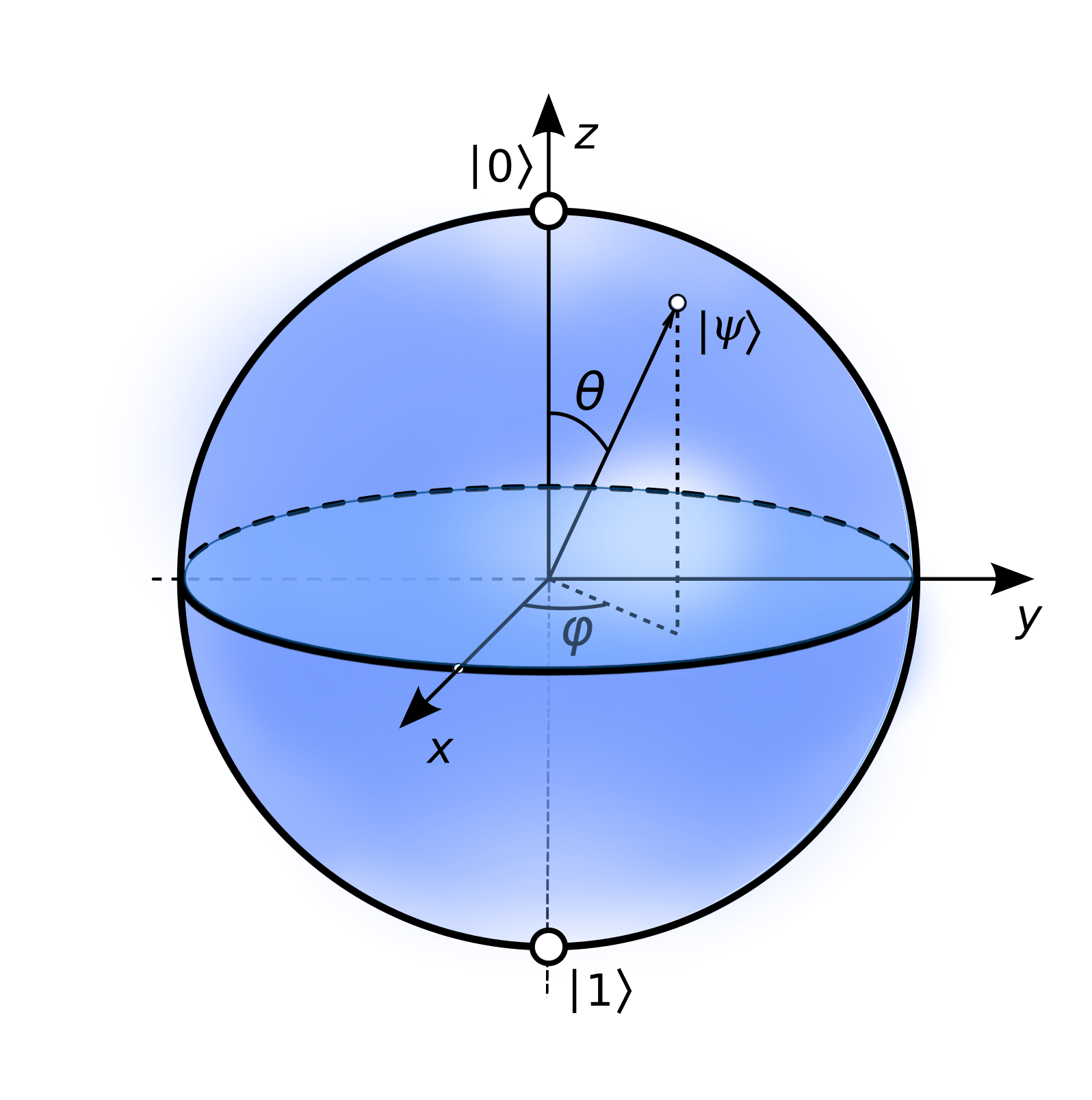
- In Dirac (bra–ket) notation, commonly used in quantum theory and quantum algorithms (see Eq.(1))
- In column-vector (matrix) representation, which is useful for computations and simulations, the same physical state can be written as:
$$ |\psi \rangle = \begin{bmatrix} \alpha \\ \beta \end{bmatrix}, \quad |0 \rangle \equiv \begin{bmatrix} 1 \\ 0 \end{bmatrix}, \quad |1 \rangle \equiv \begin{bmatrix} 0 \\ 1 \end{bmatrix} $$
-
For geometric visualization, the Bloch sphere representation is commonly used:
\begin{aligned} |\psi \rangle = \cos \frac{\theta}{2} |0 \rangle + e^{i \phi} \sin \frac{\theta}{2} |1 \rangle \hspace{1em} \hfill (2) \\ \end{aligned} $$ \alpha = \cos \frac{\theta}{2}, \quad \beta = e^{i \phi} \sin \frac{\theta}{2}, $$where \(\theta, \phi \in \mathbb{R}\) are the polar and azimuthal angles. For a single qubit, the global phase factor has no physically observable effect and can be omitted.
- Superposition: A qubit can exist in a combination of \(|0 \rangle\) and \(|1 \rangle \) simultaneously.
- Measurement: When measured, a qubit collapses to either \(0\) or \(1 \) with probabilities determined by its state.
- Entanglement: Qubits can be correlated with each other in ways that have no classical counterpart.
- Interference: Quantum states can reinforce or cancel each other, enabling powerful computational effects.
For an \(n\)-qubit system, the state can be a superposition of all \(2^n\) basis states:
Each \(|i\rangle\) represents a binary combination of the \(n\) qubits' basic states and can be expressed as a tensor product of the individual qubits:
For a two-qubit system (\(n = 2\)), there are four computational basis states: \(|00\rangle\), \(|01\rangle\), \(|10\rangle\), and \(|11\rangle\), where \(|01\rangle = |0\rangle \otimes |1\rangle,\) meaning the first qubit is \(|0\rangle\) and the second is \(|1\rangle\). The general state of a two-qubit system is a superposition of all four states:
In column-vector form:
- Probabilistic nature: Measurement is inherently probabilistic. The probabilities of different outcomes are determined by the amplitudes of the quantum state according to the Born rule.
- State collapse: During measurement, the system transitions from a superposition to a definite state, turning the qubit into a classical bit. This phenomenon, known as wavefunction collapse, is a fundamental concept in quantum mechanics.
- Irreversibility: Measurement is irreversible — performing a measurement destroys information about the original superposition, which cannot be recovered.
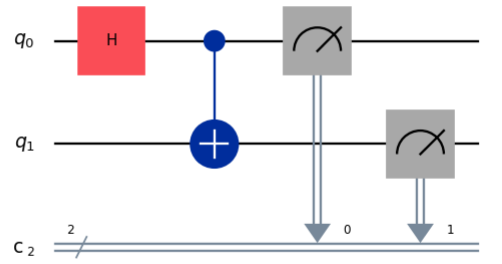
- Partial measurements: Measuring one qubit can influence correlated qubits due to entanglement (Postulate 4, composition).
- Multiple runs: Because outcomes are probabilistic, quantum computers typically run the same circuit multiple times (called shots) to estimate the distribution of results. The final result is a statistical distribution of outcomes, not a single deterministic value.
For two arbitrary quantum systems \(A\) and \(B\), with respective Hilbert spaces \(H_A\) and \(H_B\), a pure state is entangled if:
-
It cannot be written as a tensor product of individual qubit states:
$$ |\psi \rangle \neq |\psi_A\rangle \otimes |\psi_B\rangle $$
-
Equivalently, the reduced density matrix of at least one subsystem is mixed:
$$ \text{Tr}(\rho_A^2) < 1 , \quad \text{or} \quad \text{Tr}(\rho_B^2) < 1 $$
The canonical examples of maximally entangled two-qubit states, known as the Bell states, are:
Quantum entanglement is a key resource in quantum cryptography and quantum communication. It enables entanglement-based Quantum Key Distribution (QKD) protocols, such as E91 and BBM92, as well as quantum teleportation and future quantum networking technologies, and forms the foundation of future quantum networking technologies.
The properties of quantum gates are defined by the postulates of quantum mechanics (Postulate 2).
The output state can be obtained by applying a unitary matrix \(U\) to the initial state: $$ |\psi'\rangle = U |\psi\rangle $$ where \(U^\dagger U = U U^\dagger = I\), and \(U^\dagger\) denotes the conjugate transpose of \(U\). This ensures reversibility and conservation of probability.
\(I|0\rangle = |0\rangle\)
\(I|1\rangle = |1\rangle \)
The Pauli X, Y and Z equate, to a rotation around the \(x\), \(y\) and \(z\) axes of the Bloch sphere by \(\pi\) radians, respectively.
Flips computational basis states:
\( X|{0}\rangle = |{1}\rangle \)
\( X|{1}\rangle = |{0}\rangle \)
Adds a relative phase of \( \pm i \):
\( Y|{0}\rangle = i|{1}\rangle \)
\( Y|{1}\rangle = -i|{0}\rangle\)
Adds a relative phase of \(\varphi = \pi\) to \(|1\rangle\):
\( Z|{0}\rangle = |{0}\rangle \)
\( Z|{1}\rangle = -|{1}\rangle \)
It converts the computational (Z) basis \({|0\rangle, |1\rangle} \) into the X-basis \({|+\rangle, |-\rangle} \). Up to a global phase, this corresponds to a \(\pi\)-rotation around the \( (\hat{x} + \hat{z})/\sqrt{2}\) axis on the Bloch sphere.
\(H|{1}\rangle = \frac{|{0}\rangle - |{1}\rangle}{\sqrt{2}} = |-\rangle\)
Leaves \(|0\rangle\) unchanged and adds a relative phase of \(\varphi = \pi/2\) to \(|1\rangle\):
\( S|1\rangle = i|1\rangle \)
Leaves \(|0\rangle\) unchanged and adds a relative phase of \(\varphi = \pi/4\) to \(|1\rangle\):
\( T|1\rangle = e^{i\pi/4}|1\rangle \)
| Category | Protocols |
|---|---|
| Prepare-and-Measure | BB84, B92, DPS-QKD, SARG04, COW |
| Entanglement-Based | E91, BBM92 |
| Enhanced Practical Security | MDI-QKD, Twin-Field QKD |
Recent research has focused on improving the security and practical deployment of QKD through protocols such as Measurement-Device-Independent QKD (MDI-QKD), Twin-Field QKD (TF-QKD), Device-Independent QKD (DI-QKD), and Continuous-Variable QKD (CV-QKD). Among these protocols, BB84 is the first and most widely studied QKD protocol and serves as the starting point for understanding quantum cryptography.
Among the quantum key distribution protocols introduced above, we will use BB84 as an example to illustrate the fundamental principles of quantum cryptography. First proposed by Charles Bennett and Gilles Brassard in 1984, the BB84 protocol enables two parties to establish a shared secret key whose security relies on the fundamental laws of quantum mechanics.
|
Goal Establish a shared secret key while detecting eavesdropping Quantum Resource Polarization states of single photons encoded in two measurement bases Principle Measuring an unknown quantum state disturbs it, introducing detectable errors Advantages • Detects eavesdropping • Security based on quantum mechanics • Solves the key distribution problem Limitations • Requires specialized quantum hardware • Limited communication distance • Generates secret keys rather than encrypting messages directly |
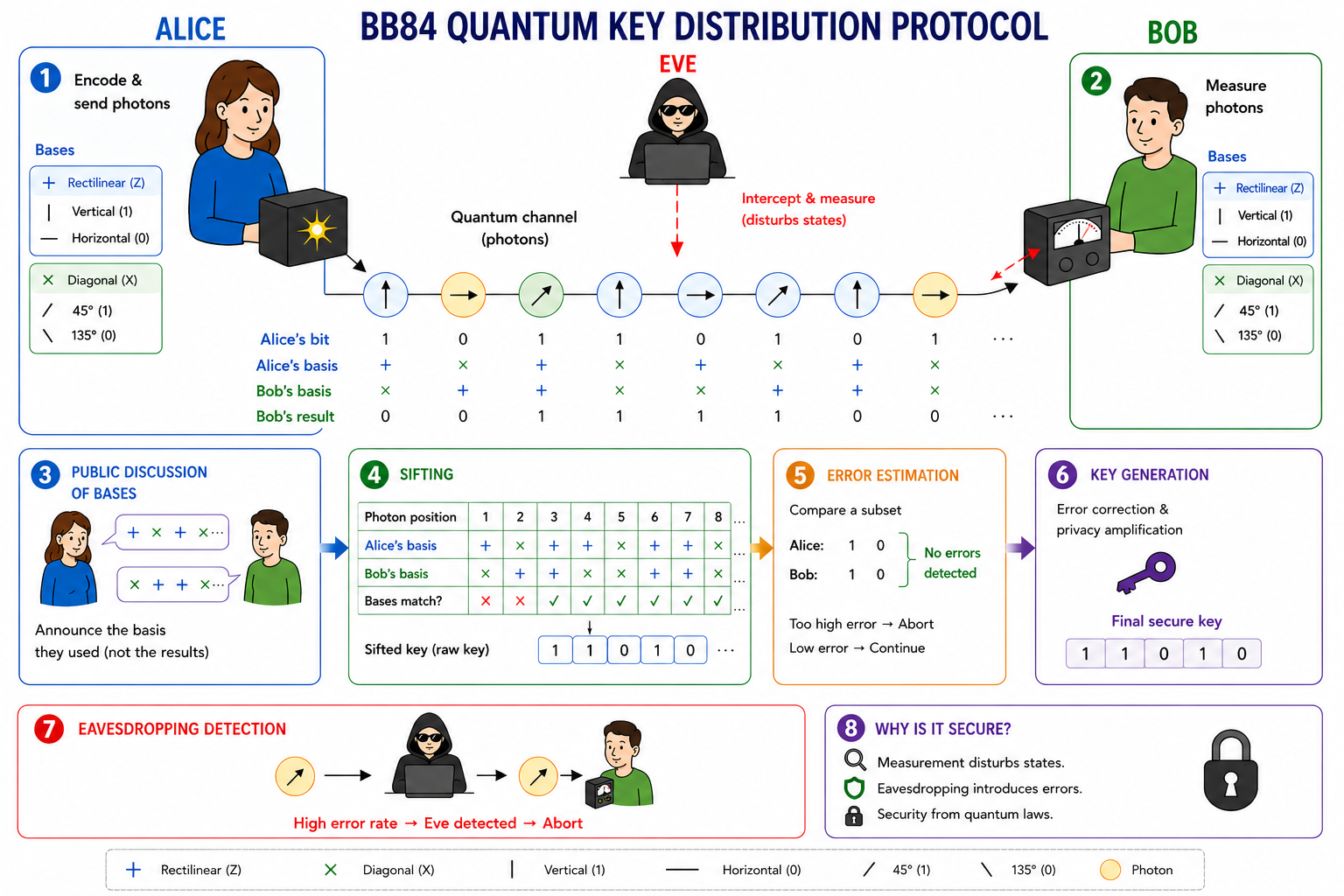
Image generated with AI assistance
|
After the BB84 protocol has established a shared secret key, the key can be used with a symmetric encryption algorithm such as AES or the One-Time Pad to protect confidential information.
- Alice prepares photons: Alice generates random bits and randomly chooses a basis (+ or x) for each bit. The resulting quantum states are encoded into photons and transmitted to Bob.
- Bob measures photons: For each received photon, Bob randomly chooses a measurement basis (+ or x) and records the result.
- Basis comparison: Alice and Bob publicly reveal only the bases they used. The bit values remain secret.
- Sifting: Alice and Bob keep only the positions where their bases match. These bits form the sifted key.
- Error estimation: Alice and Bob publicly compare a small random subset of the sifted key to estimate the error rate.
- Decision: If the error rate is sufficiently low, the remaining bits can be used to generate a shared secret key. Otherwise, the key is discarded.
- Secure key generation: The final shared key can then be used with a symmetric encryption method, such as AES or the One-Time Pad.
Choose the number of photons used for the BB84 protocol:
The goal of this challenge is to find the secret key used to encrypt a phrase. The key consists of a sequence of quantum gates forming a quantum circuit that serves as the encryption mechanism. By applying the key (the chosen encryption quantum circuit) in reverse order, the original phrase can be recovered.
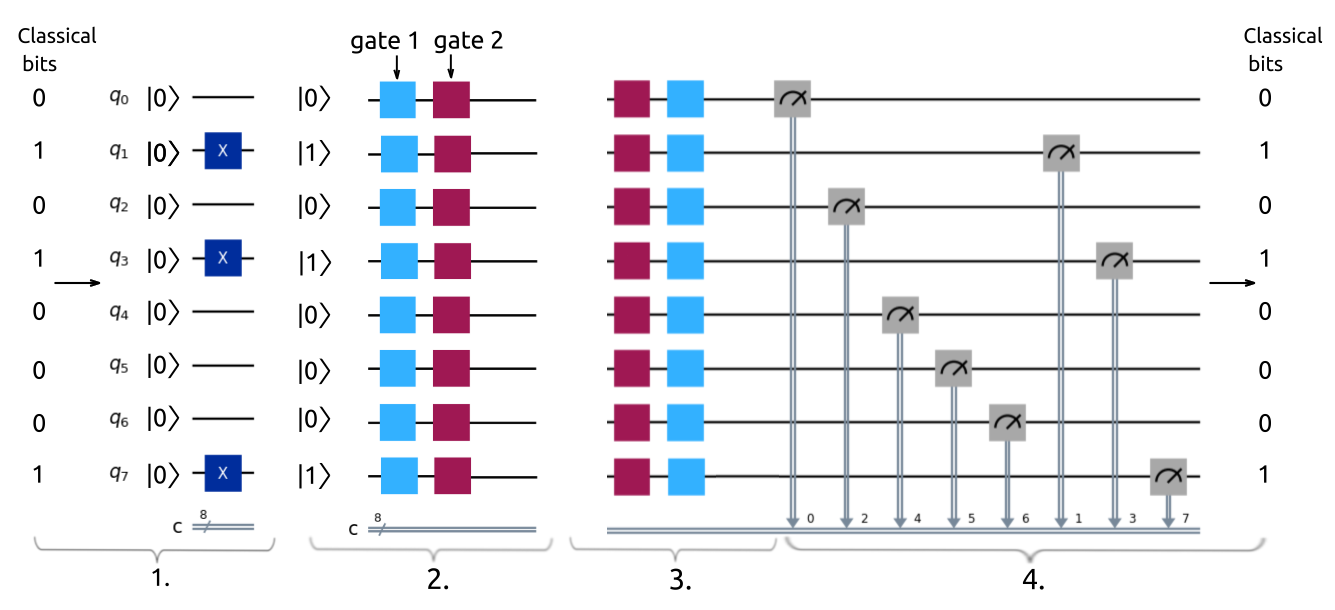
We start by preparing the quantum register according to the classical message, encoding classical bits into qubits:
- If the bit is 0, keep the qubit in the state |0⟩.
- If the bit is 1, apply an X gate (bit-flip gate) to transform |0⟩ into |1⟩.
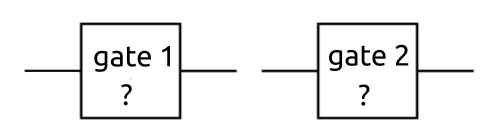 composed of two randomly selected gates:

The No-Cloning Theorem states that it is impossible to create an identical copy of an arbitrary unknown quantum state. This guarantees security because any attempt to measure or clone a quantum state disturbs it, revealing the presence of an eavesdropper.
THE PROJECT IS SUPPORTED BY