Radioactive decay is the spontaneous change in the composition (atomic number \(Z\), mass number \(A\)) or internal structure of unstable atomic nuclei through the emission of elementary particles, gamma rays, and/or nuclear fragments. This process is also referred to as radioactivity.
The next main types of radioactive decay can be distinguished:
- Alpha decay — accompanied by the emission of alpha particles: the nucleus of a helium atom (\(^{4}_{2}\text{He}\)), consisting of 2 protons and 2 neutrons. Alpha radiation has low penetration power but high ionizing power.
- Beta decay — a process in which a nucleus emits a beta particle (electron or positron). By this process, unstable atoms obtain a more stable ratio of protons to neutrons. \(\beta\)-radiation has greater penetration than \(\alpha\)-particles but moderate ionizing power
- Gamma decay — accompanied by the emission of gamma quanta, that has very high penetration power.
In this module, natural radioactivity — when atoms decay spontaneously — will be considered. Most chemical elements with atomic numbers greater than 82 are unstable, and their nuclei tend to transform into more stable configurations through the emission of alpha, beta, or gamma radiation. This spontaneous process continues until a stable isotope is formed. Artificial radioactivity, on the other hand, occurs when stable nuclei are made radioactive through nuclear reactions, but it will not be discussed in detail here.
Select the basic parameters for the simulation of the \(\alpha\)-decay for
Alpha particle energy: \(E^{\text{kinetic}}_{\text{initial}}=\) MeV
Alpha particle mass: \(\mu=\) uma
\(V_0=\) MeV, \(\sigma=\) fm
The orbital number:
\(l=\)
Choose the well profile:
Enter the number of spatial points:
\(N_r=\)
Enter the x-coordinates of the quantum well:
\(r_0=\) fm , \(r_L=\) fm
The number of eigenvalues to be displayed: \(N_{eig}=\)
The main parameter that characterize alpha decay are the energy of the \(\alpha\)-particle and the half-life \(\tau_{1/2}\) in [s] which can be expressed in terms of the decay constant \(\Gamma\) in [\(\text{s}^{-1}\)] According to the law of radioactive decay, they are related by: $$ \tau_{1/2} = \frac{\ln 2}{\Gamma} $$
As first demonstrated by Gamow, the decay constant can be expressed as \(\Gamma = T/\tau \), where \(T\) is the tunneling probability of the alpha particle through the potential barrier, and \(\tau\) is the time between two successive collisions of the particle with the barrier. The quantity \(\tau\) can be estimated from classical considerations if the nuclear radius, mass, and energy of the \(\alpha\)-particle are known. $$ \tau = \frac{2R}{v} \quad \text{with} \quad v = \sqrt{\frac{2E^{\text{kinetic}}_{\text{initial}}}{\mu}} $$
Thus, the problem of determining the half-life of a nucleus is equivalent to calculating the tunneling probability of the \(\alpha\) particle through the potential barrier.Eigenvalues and vectors: MeV
Today, \(\alpha\)-decay has found applications in a variety of fields, including medicine, energy generation, cancer treatment, detectors, environmental monitoring, and materials science. In this module, we present the operating principles of Radioisotope Thermoelectric Generators (RTGs), which have been widely used in NASA's long-term missions - for example, from Voyagers 1 and 2 to the Mars rovers.
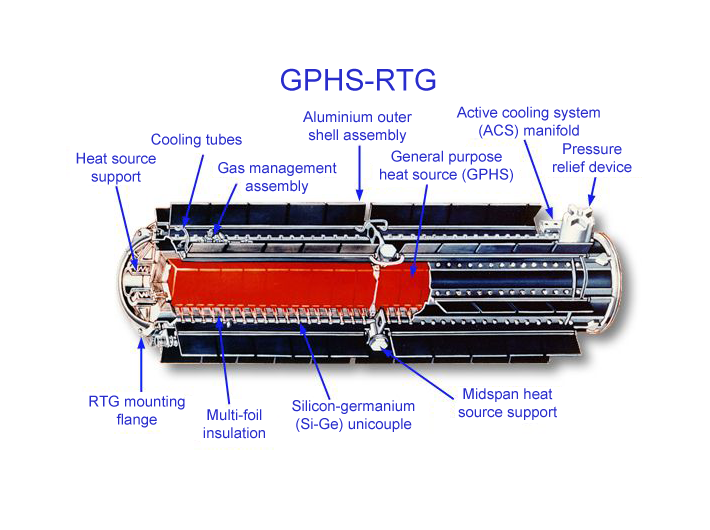
In an RTG, the kinetic energy released by the spontaneous emission of \(\alpha\)-particles from radioactive isotopes is converted into thermal energy,
which is absorbed by the surrounding material and subsequently transformed into electricity in thermocouples through the Seebeck effect.
The natural decay of a radioactive isotope (for example, plutonium-238) generates heat that is transferred to one side of the thermocouple,
creating a temperature difference between the fuel and the surrounding environment.
This temperature gradient enables the device to convert heat into electrical energy.